The Most/Recent Articles

Showing posts with label Politics. Show all posts

‘All of Kuwait is Under Review’ – including its diplomats

Image Source: Shutterstock

Over 50,000 people have had their Kuwaiti nationality stripped as the Gulf state continues its purge of ‘forged’ nationalities. Now, they have added the Kuwaiti Ambassador to the UK to the list.

In March of last year, Kuwait's new monarch, Emir Mishal Al-Ahmad Al-Jaber Al-Sabah launched a policy claiming to target foreigners who illegally obtained their Kuwaiti citizenship. In the ensuing months, the policy has been interpreted more and more broadly, with nationalised citizens and political opponents reportedly being affected by the campaign.

His Excellency Ambassador Bader Al-Awadhi is the latest high-profile Kuwaiti to be affected as the Supreme Committee for Citizenship Investigation announces citizenship can be revoked in cases of dual nationality, forgery or misconduct.

It begs the question, if citizenship can be revoked for a finding of ‘misconduct’, what does misconduct mean?

This quiet crisis began with the escalating repression of Kuwaiti’s critics in 2024 when a Kuwaiti court sentenced Anwar Hayati to four years in prison under the State Security Law, because of online comments. Since then, nearly 50,000 people have had their citizenship revoked.

Now, Sheikh Fahad Yousef Saud Al Sabah, Kuwaiti’s First Deputy Prime Minister and Minister of the Interior told Al Qabas newspaper that ‘All nationality files in Kuwait are under review and subject to detailed scrutiny without exception’.

The denaturalisations have been justified as a campaign against foreign nationals who are living off the generous welfare benefits meant for Kuwaitis, with the Emir describing it as a national effort to ‘restore Kuwait to its rightful people, clean and free of impurities’.

Interior Minister Sheikh Fahad Al-Youssef further stated that: ‘Kuwait was held hostage by forged nationalities. We are now returning it to its true citizens’.

The government has also opened a ‘hotline’ to encourage Kuwaitis to report dual nationals and to denounce others who may have procured their nationality through false documentation.

Following a royal directive, the Kingdom of Bahrain has renewed the passports of its citizens stripped of Kuwaiti nationality in light of recent events. This swift intervention has filled a legal and logistical gap created by the loss of Kuwaiti documentation.

Dual nationals, political opponents and now, Kuwait’s own ambassadors. In a move that sparked great debate on social media platform X, reports have circulated that the current ambassador has had his citizenship revoked as well as that of his father and all those descended from him. The news was announced on the platform from an opposition account called ‘Freedom for the Oppressed Free’ in a post which has accrued over 94k views. The post shows an image of what appears to be the decree revoking the name of ‘Mohammed Ibrahim Ismail Al-Awadhi’, the late diplomat and father to Kuwait’s current ambassador.

Kuwaiti newspaper Al-Dowlia, licensed by the Ministry of Information, categorically denied the circulating reports about the withdrawal of the ambassador’s citizenship.

The Kuwaiti Cabinet has recently issued a new circular outlining the obligations of individuals whose citizenship has been revoked under Article 5/Third of the Nationality Law, a provision that encompasses those who gained nationality through dependency.

The directive seeks to clarify privileges between citizenship and legal status and the social and economic realities of those who previously held citizenship, drawing a firm line under privileges no longer available to those without.

While this new circular protects nine entitlements (travel, employment, education, residence ownership, housing benefits, personal assets, investment rights, access to finance and welfare) designed to mitigate the immediate impact of nationality withdrawal, it is clear that Kuwait is firmly asserting its sovereign authority to regulate nationality under the guise of maintaining social order.

The campaign has also stripped citizenship other well-known figures such as Islamic preacher Nabil Al-Awadi and journalist Mubarak Al-Omair, with reports that goalkeeper and preacher Ahmad Al-Tarabulsi could also have been affected.

The increasingly concerning pattern of mass denaturalisation in Kuwait is suggestive of a more concerning question taking root in Kuwait’ society: whether the new Emir is committed to maintaining the rule of law and the fundamental rights and freedoms that have built Kuwait since becoming fully independent in 1961. Citizens are asking – where will it end?

The US President Expands National Guard Deployments: Attorney Eric Gang Defines When Guardsmen Become True Veterans

Eric Gang
Image Source: Eric Gang

Written by Jon Stojan

The president’s recent decision to deploy National Guard units to Washington in response to crime has reignited a longstanding debate: when does a guardsman’s service cross the threshold into veteran status, and what benefits should follow? For Eric Gang, founder of Gang & Associates and one of the nation’s leading veterans’ rights attorneys, the distinction is not just a matter of legal technicality; it can determine whether an injured guardsman receives federal benefits for life or nothing at all.

Gang & Associates
Image Source: Gang & Associates

“Every state and territory has a National Guard,” Gang explains. “They are often called up during natural disasters or civil disturbances. But the real difference is who calls them, whether it’s the governor or the president. That difference shapes what benefits they may ever receive.”

If a governor activates the Guard, the mission is considered state service. Should a soldier be injured while filling sandbags after a flood or helping a community recover from a tornado, they may receive some state-level benefits but not federal veterans’ compensation. By contrast, when the president activates the Guard under federal orders, that service is treated as active duty for federal purposes. As Gang emphasizes, “If a guardsman is injured in the line of duty under federal activation, he is considered a veteran, and that opens the door to VA benefits, from disability compensation to education support and home loans.”

The stakes are particularly high as Guardsmen are deployed into urban environments marked by violent crime. “It’s one thing to support disaster relief,” Gang notes. “It’s another to be placed in the middle of unrest, where there are illegal guns on the street, where people may view them as hostile forces. These guardsmen face real risks, being shot at, assaulted, or even exposed to infectious diseases.”

Gang’s work has made him a national voice on when Guard service counts as federal duty. His firm litigated Watkins v. McDonough, a landmark 2022 case in which the Court of Appeals for Veterans Claims considered when active duty officially begins. Gang argued successfully that a service member is deemed on active duty starting at 12:01 a.m. on the date listed in their orders, not just when they report later in the day. “If someone is ordered to report at 8 a.m., and they get into a car accident on the way at 7 a.m., that still counts,” Gang says. “The law recognizes that from the first moment of that day, they are subject to military justice, and they should also be entitled to veterans’ benefits.”

Veterans Disability Info
Image Source: Veterans Disability Info

That interpretation matters. Guardsmen activated federally who suffer an injury, even en route to their duty station, can claim VA benefits if it occurred after 12:01 a.m. on their activation date. For Gang, this legal nuance ensures fairness. “It wouldn’t make sense,” he stresses, “to hold someone accountable to the Uniform Code of Military Justice from 12:01 a.m. but deny them benefits if they were hurt that same morning.”

The line is sharper for National Guard service under governors. Those missions, however necessary for public safety, are not considered active duty in the federal sense. “It can feel unfair,” Gang acknowledges. “But Congress has drawn that line. State-activated guardsmen don’t qualify for the same VA benefits, because their duty is not considered federal service.”

This split, he says, has deep political roots. Gang points to parallels with the civil rights era, when federal authorities deployed the Guard to enforce school desegregation over the objections of state governors. “We have always had tension between state and federal authority,” Gang observes. “Today, it plays out in debates over crime and immigration enforcement. But the ones caught in the middle are the guardsmen themselves. They are not political actors; they are simply doing their job.”

Gang stresses that these men and women should not be scapegoated. “They are innocent parties. They don’t decide where they are sent or who sends them. They deserve clarity about their status and the assurance that, if they are harmed in service, their country will take care of them.”

As deployments expand to other cities facing high crime, the questions that Gang raises grow more urgent. Guardsmen activated federally will qualify for VA benefits if injured or if they contract a disease in the line of duty. Those activated by governors may not. The distinction is critical for the thousands of citizen-soldiers who balance civilian lives with part-time service, and who may suddenly find themselves on the frontlines of contentious crises.

“It’s important for these individuals to know what is included when they are deployed,” Gang says. “Understanding when active duty starts, and under whose authority they are serving, can make all the difference in their future.”

USA

Why semiconductors are central to world economy, geopolitics


The Chinese Communist Party Congress opens in Beijing on October 16, a week after Washington imposed tight restrictions on exports of invaluable semiconductor technology to China in a bid to stop it from surpassing the US economically and militarily. As semiconductors emerge as a key battleground, FRANCE 24 spoke to the author of a new bestseller on these all-important pieces of silicon.

For years, semiconductors have been crucial to everything from fridges to ballistic missiles. But only recently have they captured public attention.

Washington demonstrated the US semiconductor industry’s almighty power in 2018 when Donald Trump’s Commerce Department banned Chinese telecoms firm ZTE from buying chips designed in the US. These measures nearly drove the company to collapse before the erratic then-president reversed the measure.

But semiconductors only came to dominate the headlines in early 2021. A constellation of factors – notably Covid lockdowns warping consumer demand – sparked a chip shortage crisis, which pushed up inflation and caused shortages of goods from cars to mobile phones.

Now the spotlight is on semiconductors once more ahead of the Chinese Communist Party Congress, after President Joe Biden’s Commerce Department unveiled on October 7 sweeping new measures curtailing US exports of semiconductor technology to China. This was part of Biden’s response to President Xi Jinping’s plans to wean China off US-designed chips and make it a world leader in the sector.

To look more closely at how semiconductors rose to the forefront of international economics and politics, FRANCE 24 spoke to Chris Miller, author of the recently published bestseller "Chip War" and associate professor of international history at Tufts University, visiting fellow at the American Enterprise Institute and Eurasia Director at the Foreign Policy Research Institute.

What are semiconductor chips and how did they become so central to the world economy and daily life?

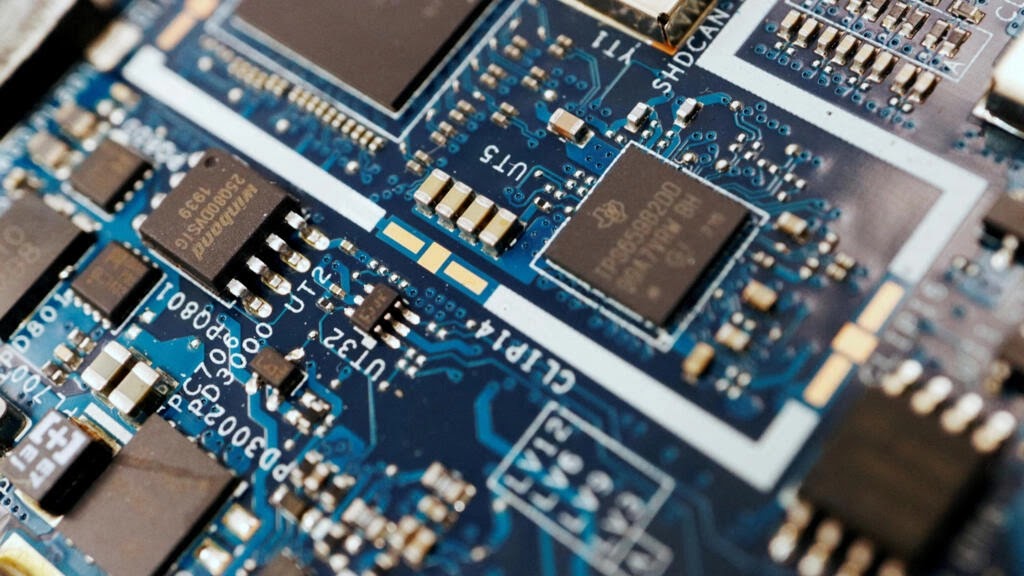
Semiconductors are small pieces of silicon with millions and billions of tiny circuits carved into them. These circuits provide the computing power inside almost any device with an on-off switch: smartphones, computers, datacentres, automobiles and dishwashers.

The typical person will interact with dozens if not hundreds of semiconductors each day, though we almost never see them.

How important was the US’s advantage in semiconductors to its victory in the Cold War?

The US advantage in computing was crucial. From the earliest days of the missile race, the Pentagon was fixated on applying computing power to defence systems. The first major application of chips was in missile guidance systems, but today they are used in everything from communications to sensors to electronic warfare.

Just as the typical person will interact with dozens of chips each day, militaries are crucially reliant on chips' processing power and signals processing capability. What’s more, as militaries begin to experiment with increasingly autonomous systems, they’ll be even more reliant on advanced chips.

How did Taiwan – specifically the Taiwan Semiconductor Manufacturing Company (TSMC) – come to nearly dominate chip manufacturing? And what would happen to the world economy if TSMC’s facilities in Taiwan are damaged in war?

TSMC is the world’s most advanced maker of processor chips, thanks to its enormous scale and extraordinary manufacturing precision. Today, TSMC produces 90 percent of the most advanced processor chips, which go into everything from smartphones to PCs to datacentres.

If a war were to knock their production offline, the cost to the global economy would be measured in the hundreds of billions of dollars.

In Europe there’s this perception that we are behind when it comes to high-tech industries, but Dutch company ASML is the big exception to this. How did it come to play an invaluable role in chip manufacturing?

ASML produces the machines without which advanced chips can’t be made.

ASML’s specialisation is in lithography, and it has 100 percent market share in the production of the most advanced lithography machines. It has honed these capabilities over many years and today is a critical supplier to companies like Samsung, TSMC and Intel.

Do you think China has what it takes to match or supersede the US when it comes to semiconductors?

For several years now, Washington has been worried about the national security implications of China catching up in the semiconductor business, especially in light of Xi Jinping’s Made in China 2025 initiative making chips a top priority.

China has been investing many tens of billions of dollars into government chip-development programs. These programmes have delivered substantial progress in some spheres, notably chip design.

However, across the board, China remains far behind capabilities in the US, South Korea or Taiwan in terms of fabricating chips. In addition, all chip fabrication in China today relies on machine tools imported from abroad, largely from the US, the Netherlands and Japan.

Do you think President Joe Biden’s plans to bring more chip production back to the US are a good idea, given the security implications of the overwhelming majority of manufacturing of advanced processor chips being based in Taiwan?

Today 90 percent of the world’s most advanced processor chips are produced in Taiwan. Given China's growing military might and Xi Jinping’s aggressive nationalism, this is a risk to the global economy that has grown too large.

Efforts to diversify the geography of advanced chipmaking are a smart move from this perspective. This explains why the US, Japan and Europe are all trying to bolster their countries’ position in the semiconductor supply chain.